UniBuddy: Making College Bureaucracy Easy for Every Student
Industry
Education / EdTech
Design Category
Capstone / Product Design
Timeline
Jan 2026 – May 2026
Team
Elaine Zhang, Iman
Impact
4 Student Archetypes
User research spanned international, first-gen, transfer, and second-generation students — revealing 3 consistent structural failure modes and a clear theory of change that shaped every design decision across two prototype iterations.
$3.75B Problem Space
Targets the $3.75B in annual unclaimed federal aid and 10–20% summer melt rate — bureaucratic drop-offs disproportionately affecting students navigating 15–25 post-acceptance tasks with no guide and no institutional knowledge safety net.
Background
The U.S. hosts 1.1 million international students annually — up 12% year over year — and roughly 56% of four-year undergraduates are first-generation. These students share a common obstacle: post-acceptance navigation requires completing 15–25 administrative tasks across 6–10 separate platforms and offices, each with its own deadline, its own login, and its own language written for compliance, not comprehension. For students whose parents attended U.S. universities, the institutional knowledge required to navigate this is invisible infrastructure — absorbed through family conversation before the first application is ever submitted.
UniBuddy is a mobile-first task-completion platform built to close that gap. Developed as a Brown University capstone in EDUC 1775, it delivers plain-language, personalized, proactive guidance on the administrative steps between admission and first semester: I-20 requests, SEVIS payments, FAFSA verification, housing deposits, immunization compliance, and course registration. The platform translates the hidden curriculum into concrete, sequenced action steps — with dependency mapping, inline AI guidance, and ready-to-send email drafts — so that navigational competence is no longer determined by family background.
The U.S. hosts 1.1 million international students annually — up 12% year over year — and roughly 56% of four-year undergraduates are first-generation. These students share a common obstacle: post-acceptance navigation requires completing 15–25 administrative tasks across 6–10 separate platforms and offices, each with its own deadline, its own login, and its own language written for compliance, not comprehension. For students whose parents attended U.S. universities, the institutional knowledge required to navigate this is invisible infrastructure — absorbed through family conversation before the first application is ever submitted.
UniBuddy is a mobile-first task-completion platform built to close that gap. Developed as a Brown University capstone in EDUC 1775, it delivers plain-language, personalized, proactive guidance on the administrative steps between admission and first semester: I-20 requests, SEVIS payments, FAFSA verification, housing deposits, immunization compliance, and course registration. The platform translates the hidden curriculum into concrete, sequenced action steps — with dependency mapping, inline AI guidance, and ready-to-send email drafts — so that navigational competence is no longer determined by family background.
Problem
How might we give first-generation and international students access to the same institutional knowledge that advantaged students inherit automatically — so that navigating college bureaucracy is determined by capability, not by family background?
Every existing guidance resource stops at the admission deposit. University websites are organized around administrative departments, not student journeys. The average counselor-to-student ratio is 376:1 — more than 50% above the recommended maximum. Private advisors charge $2K–$100K. The high school class of 2021 left $3.75 billion in federal Pell Grant aid unclaimed because more than 1.7 million students did not file the FAFSA. Summer melt — the drop-off between admission and matriculation — runs at 10–20% nationally and disproportionately affects the students with the fewest support structures. The cause is not student capability. It is differential access to institutional knowledge that was never communicated clearly and that no tool has ever made legible at the moment students need it most.
Solution
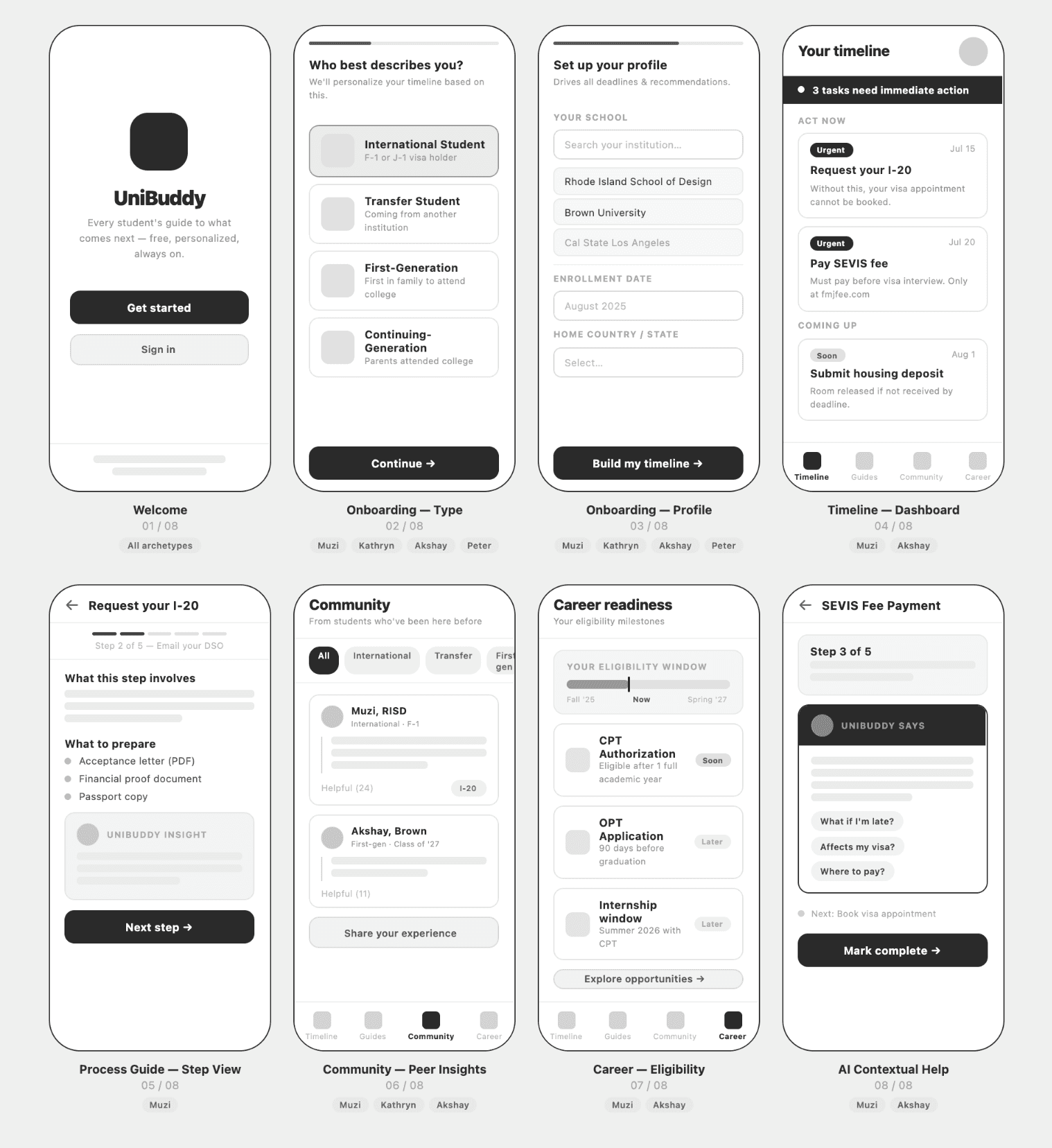
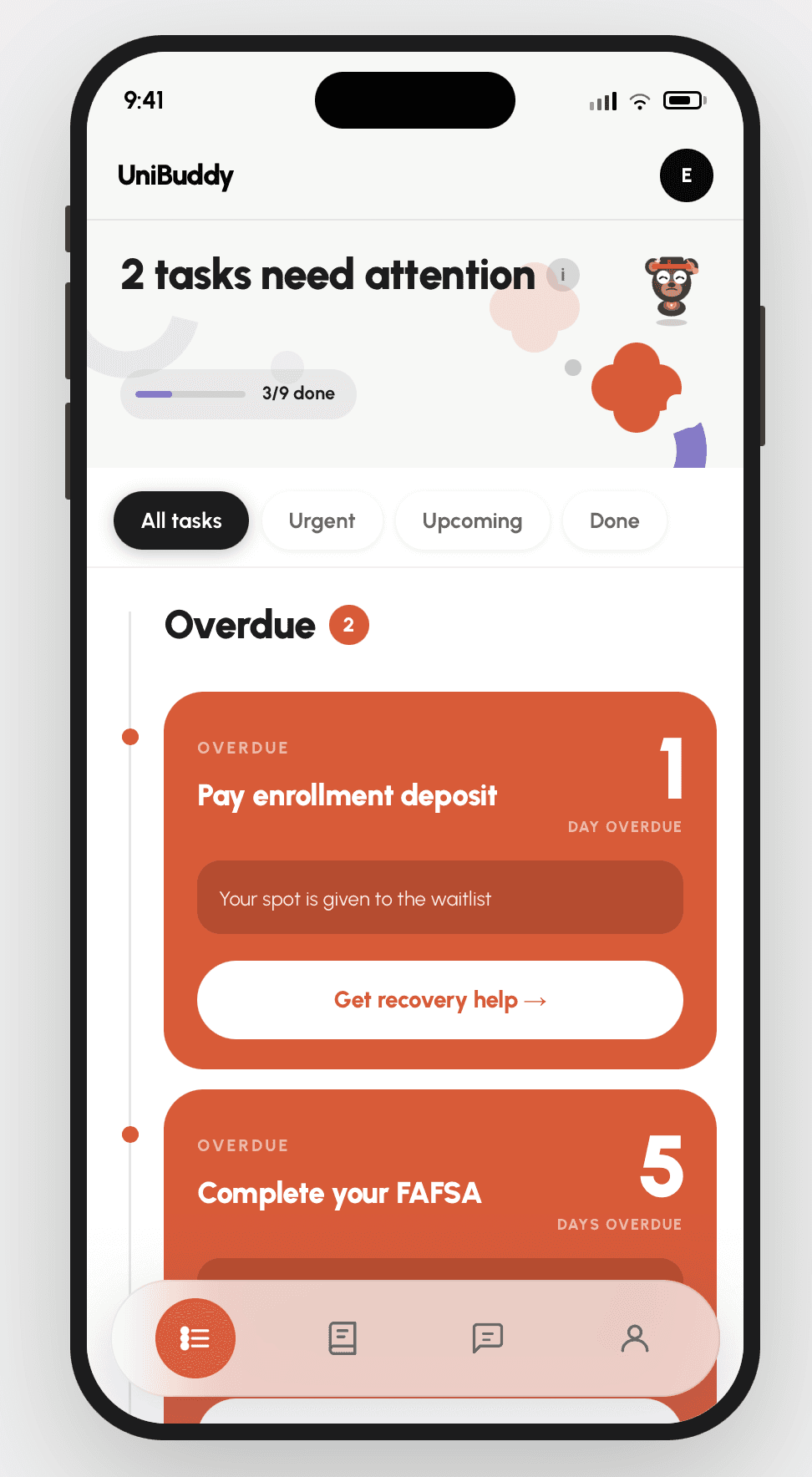
UniBuddy is a mobile-first task-completion platform that guides first-year students through the bureaucratic steps between admission and first semester. The focused v1 experience spans three screens: a personalized priority timeline, step-by-step process guides with inline AI, and a conversational onboarding profile.
Jump to Process
Personalized Timeline
A priority stack organized by urgency and consequence, personalized to the student's type, home country, enrolled institution, and arrival date. Each card shows its deadline, its consequence if missed, and which tasks depend on its completion — surfacing the dependency chain before students hit it.
Process Guides with Inline AI
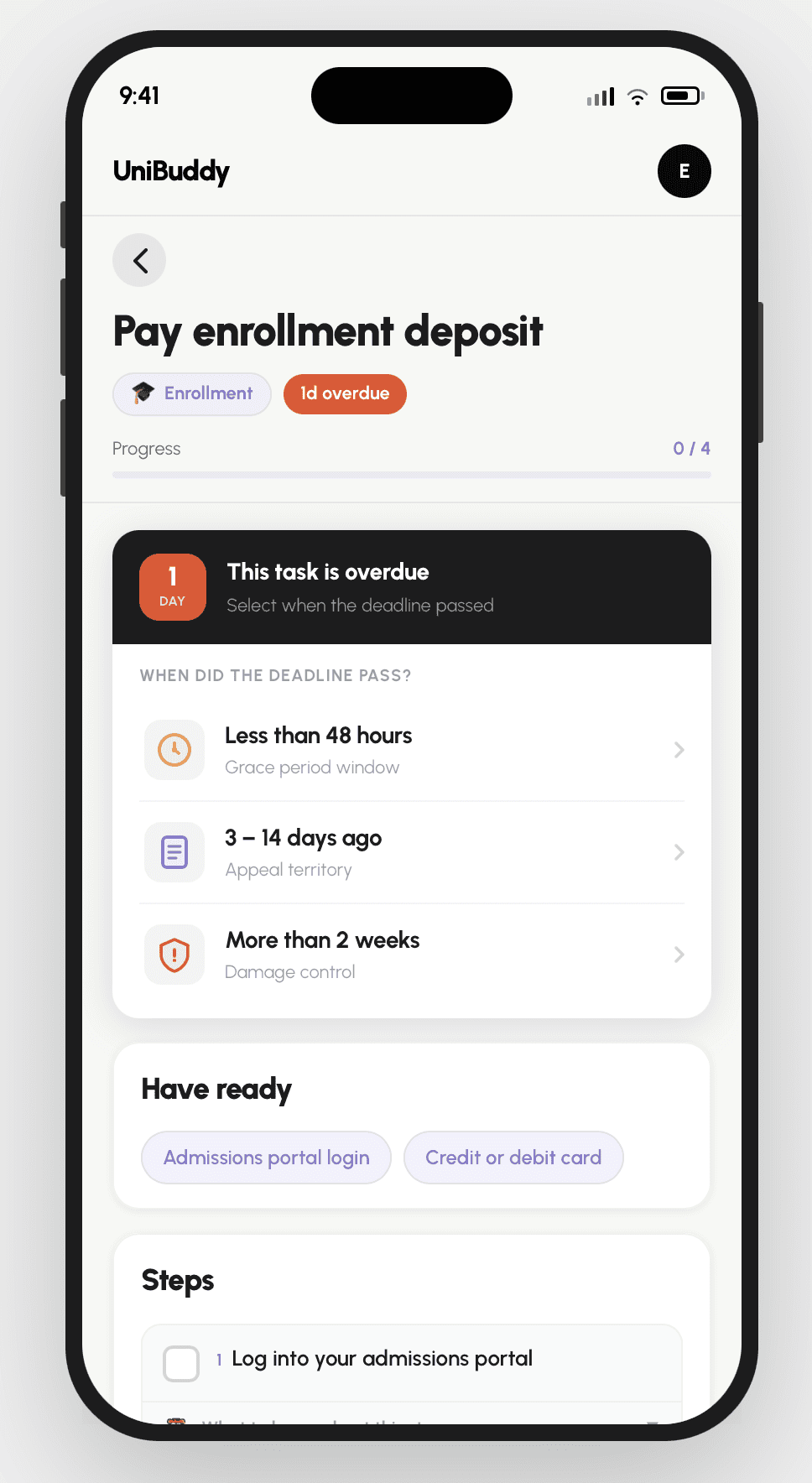
Full walkthroughs for each administrative task: what it is, why it matters, what to gather, step-by-step instructions, and an embedded ready-to-send email draft to the right contact. The AI appears as an inline contextual block within every guide — always specific to the student's profile, never a separate chat tab that requires students to know what to ask.
Dependency Mapping
Students cannot register for courses until they clear a financial hold they may not know exists. The timeline shows task dependencies explicitly so students understand the complete sequence before hitting a blocker — one of the most consistently validated design decisions across both rounds of user testing.
Research
We conducted in-depth qualitative interviews with four students representing the primary affected populations — international, first-generation, transfer, and second-generation American — and triangulated findings with peer-reviewed research on summer melt, FAFSA completion, virtual advising, and behavioral barriers during college transition.
User Interviews
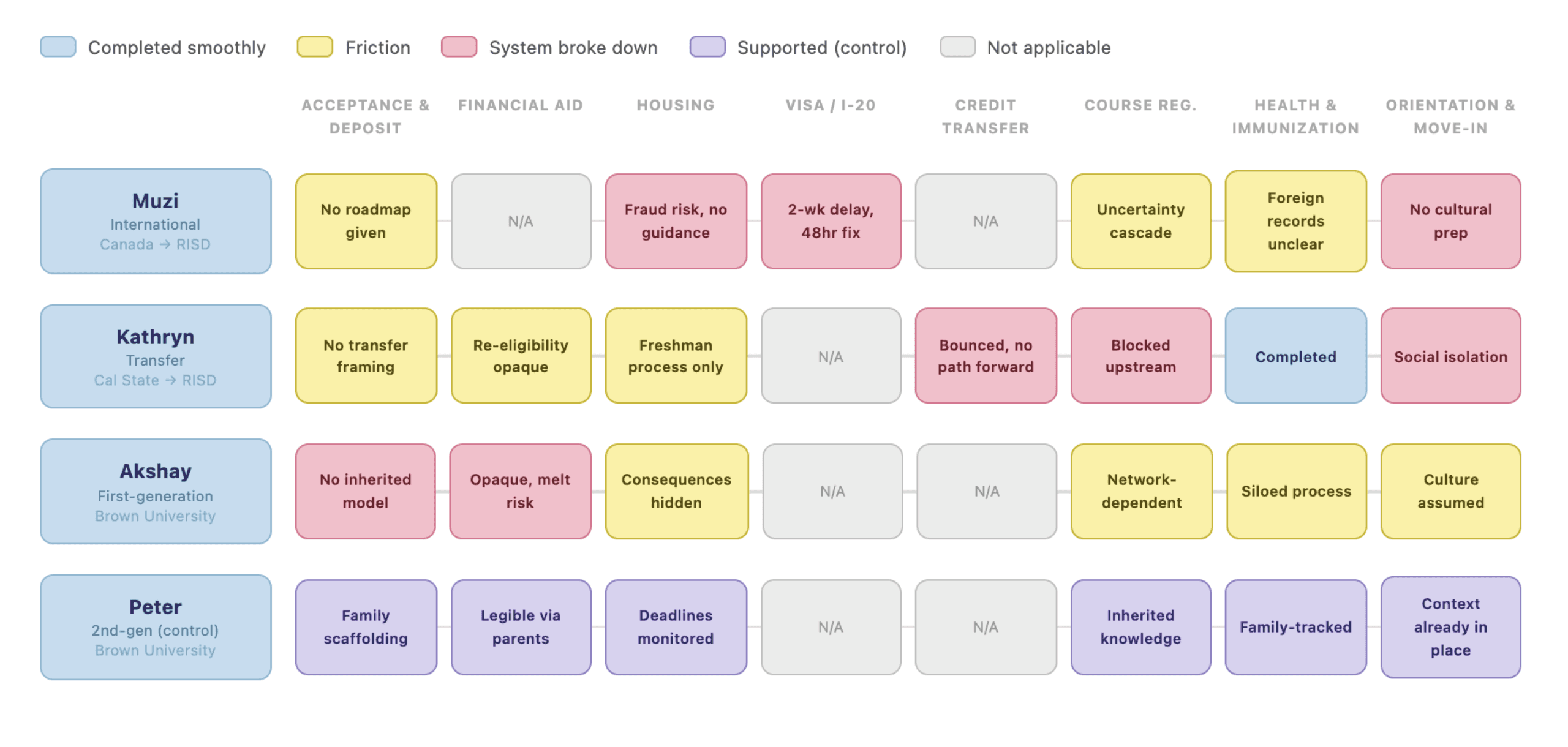
Muzi (international, RISD) arrived without understanding critique culture, nearly signed a fraudulent housing lease remotely, and spent two weeks unclear on her I-20 timeline with no one to ask. Kathryn (transfer, Cal State → RISD) was redirected between departments for every single question. Credit transfer required repeated self-advocacy that nobody told her she would need. "Need to constantly search things up for every detail — zero preparation." Akshay (first-gen, Brown): "If I didn't have the networks then I wouldn't have known what to do." Peter (second-gen, Brown) had parents who hired counselors, toured 15 schools, and provided the accountability structure that made completion possible — making visible exactly what the other three were navigating without.
Structural Failures
Three structural failure modes appeared consistently across all four interviews, regardless of student type. Bureaucratic illegibility: institutional processes written for compliance, not comprehension — producing missed deadlines, lost financial aid, visa compliance failures, and housing scams. Fragmentation across platforms: 15–25 tasks across 6–10 systems, each with its own deadline and login, with no one responsible for showing the complete picture. Support that stops at admission: every existing guidance resource — consultants, counselors, ranking sites — ends at the enrollment deposit, leaving students alone at the most complex administrative period of their college experience.
Theory of Change
IF first-generation and international students receive plain-language, personalized, proactive guidance on the administrative processes that determine whether they successfully enroll and persist — THEN they will complete key tasks correctly and on time, avoid costly and irreversible errors, and arrive at first semester with the knowledge and agency that advantaged students inherit — BECAUSE the primary driver of inequitable outcomes in post-acceptance navigation is not student capability but differential access to institutional knowledge that was never communicated clearly, and when that knowledge is made explicit and timely, students can act on it effectively — LEADING TO measurably lower summer melt rates, higher first-year retention among first-gen and international populations, and a reduction in the bureaucratic burden on ISS and financial aid offices who currently absorb the long tail of procedural questions.
Ideation
Prototyping Approach
Phase 2 included community feed, career planning, cultural orientation, growth tracking, and a Moves/Playbook framework. Every feature was cut by Phase 3. What remained: timeline, process guide, profile. The discipline to remove features users said they liked but didn't act on — guided by Muzi's direct feedback ("I don't need to see my growth chart, I need to know what to do next") — was the defining design decision.
Phase 2 → Phase 3 Scope Narrowing
Removed standalone AI chat tab → replaced with inline contextual blocks embedded in every task card and guide. Removed standalone social community feed → peer knowledge embedded as a single verified insight per process guide. Added explicit consequence lines to every task (generic urgency doesn't drive action; specific consequences do). Added transfer student as a distinct onboarding identity after both Muzi and Kathryn noted they were invisible at onboarding.
Preparation - Emphasis on readiness for critique sessions, including having clear objectives and materials prepared.
Guest Critic Involvement - External perspectives will provide fresh, professional insights.
Cards and Prompts (Guidelines) - Structured prompts or cards to guide discussions and maintain focus during critique sessions.
Choices of Critique Formats - Offering various critique styles, such as group discussions or individual feedback sessions to cater to diverse needs and preferences.
Key Iterations
Built a fully interactive mobile-first prototype demonstrating the 3-screen experience across 5 core surfaces, including a shareable email draft flow triggered from the I-20 process guide. Tested with 4 students representing all target archetypes.
Working Prototype
Phase II Development
Phase 2 focused on consolidating a feedback system that addresses the pain points of both critics and presenters during each phase of the final critique. The system includes a brainstorm aid, guided note-taking, and self-reflection components, ensuring critics provide productive feedback while giving presenters clear insights from diverse perspectives. This approach maximizes the value of feedback within the same timeframe, improving the efficiency of the critique process compared to traditional verbal methods.
User Testing
Round 1: Feature Scoping
Round 2: Prototype Testing
Phase 2 testing with all 4 archetypes surfaced a consistent pattern: students appreciated the community and career features but didn't act on them. Every user independently directed attention back to task completion. This shaped the Phase 3 scope decision.
Impact
4 Student Archetypes
User research spanned international, first-gen, transfer, and second-generation students — revealing 3 consistent structural failure modes and a clear theory of change that shaped every design decision across two prototype iterations.
$3.75B Problem Space
Targets the $3.75B in annual unclaimed federal aid and 10–20% summer melt rate — bureaucratic drop-offs disproportionately affecting students navigating 15–25 post-acceptance tasks with no guide and no institutional knowledge safety net.
Digital Format
The digital format made the feedback easier to read and more organized, but it lost some of the personal touch and engagement that came with handwriting. While it helped with clarity, the process of organizing, saving, and sending the files added a layer of complexity that wasn’t as intuitive as simply writing feedback by hand and passing it to a peer. The digital approach felt less spontaneous and more like a task, whereas handwriting allowed for more organic, immersive and personal exchanges.
Physical Format
The handwritten feedback approach offered a more personal and informal space for students to articulate their opinions, which helped foster a stronger sense of engagement and connection with the critique process. While some students found it challenging to organize their thoughts within the limited space of the paper, many still preferred the handwritten format for the intimacy it provided. Several reflected that the time and care it took to write their feedback made them more willing to participate thoughtfully in verbal critiques and engage more deeply with their peers’ projects.
On February 2, 2025, Critique Notes was published as part of "Evolving Design Critique for a Changing Industry" on the RISD College Commons, contributing to research on enhancing critique structures in design education. This work was developed through the ReAssembling ID course at the Rhode Island School of Design, focusing on fostering more structured, inclusive, and engaging feedback practices.
Retrospect
Key Learnings
A few things to takeaway from this very special and extensive project driven by research, real-world insights, and supportive people...
Special thanks to...
Professor Saloni Gupta — EDUC 1775 professor and advisor who guided the capstone research and prototyping process at Brown University.
Muzi, Kathryn, Akshay, and Peter — our research participants whose candor and generosity made the insight work possible.
Iman — research and prototyping partner throughout the capstone.
Capstone
A class capstone with Brown University's Nelson Center for Entrepreneurship. The brief: turn a real problem into a deployable startup in three months. That meant prototyping the product with AI on both the front and back end, building a financial model, and planning a pilot.
Overview
Guiding first-gen and international students through their first 90 days.
A mobile guide for everything students have to do after they get in, tested with four kinds of students. A few outcomes:
1Cut the prototype from 8 screens to 3, which improved task completion in every test.
2Built task timelines that spell out what happens if you miss a step, which got students to act.
3Turned the AI from a chatbot into a case manager built into each step.
Context
Most students get no help through the first 90 days after they're admitted.
We mapped the full post-acceptance process across four student archetypes and interviewed each about where the system broke down.
1.8~
2.1~
2.5~
2.9~
3.2~
SEVIS / Visa
Financial Aid
Health Clearance
Housing Portal
Course Registration
Confidence rating (1-5)
SEVIS and Financial Aid scored the lowest student confidence. Hover each bar to see what's at stake.
Competitive Landscape
Every existing tool stops before the hardest part.
University Websites
Authoritative but organized by department, not student journey
Solution
Exploration
Application
Decision
Pre-Arrival
Integration
School Counselors
Private Advisors
Reddit / YouTube
Test Prep Tools
UniBuddy
Covered
Not covered
UniBuddy coverage
Pre-Arrival and Integration are the highest-stakes stages. Zero current solutions address them.
The Problem
Every student we spoke to hit the same wall.
No unified view
15-25 tasks across 6-10 platforms, none showing what comes next.
Hidden consequences
Students discover the cost of a missed deadline only after the damage is done.
Zero dedicated tools
Every existing product stops at admission. The hardest stretch is unguided.
Student Journey
Support drops off right when the stakes are highest.
Exploration
Application
Decision
Pre-Arrival
No coverage
Integration
No coverage
User Interviews
Four archetypes. One shared gap.
Akshay
First-gen, Brown
"If I didn't have the networks, I wouldn't have known what to do."
Zero institutional guidance. One peer was his only source.
Muzi
International, RISD
"I was unsure for weeks whether missing a SEVIS payment voided my visa."
YouTube filled the gap. Institutional norms were invisible.
Kathryn
Transfer, Cal State to RISD
"Zero preparation for what was coming after I got in."
Bounced between departments. No one owned her situation.
Peter
Second-gen, Brown
"My parents kept saying just do what we did. But nothing was the same."
Prior family experience was structurally irrelevant.
Solution
Give every student the know-how that well-connected students already have.
The core insight
When students know what's coming, what it depends on, and what breaks if they miss it, they act.
Step 1
Urgency-ranked task timeline
Every post-acceptance task, sequenced by deadline and consequence, with dependency warnings built in.
Step 2
Process guides with contact context
Who to contact, what to bring, and a ready-to-send email draft. No guesswork about what to say or to whom.
Concepts Considered
Three directions evaluated. One chosen.
Impact
1
2
3
Feasibility
1
Peer Mentorship Platform
2
Static Aggregator
3
Personalized Guidance EngineChosen
Proactive. Covers the full post-acceptance arc. Scales across student types and institutions.
Design Process
We built it in React Native, then cut it down twice.
Phase 1
0 screens
Research + Framing
HMW defined
4 user interviews
Competitive analysis
Theory of change
Phase 2
8 screens
First Prototype
Community feed
Career planning
Growth streaks
Moves framework
Phase 3
3 screens
Final Product
Timeline
Process guides
Embedded AI guidance
1st Iteration
An 8-screen prototype covering onboarding, community, career, and timeline, tested with all four archetypes.
What worked
Onboarding personalization landed well across all archetypes.
What did not
Community and career tabs created confusion. They came at the wrong moment.
Second Iteration
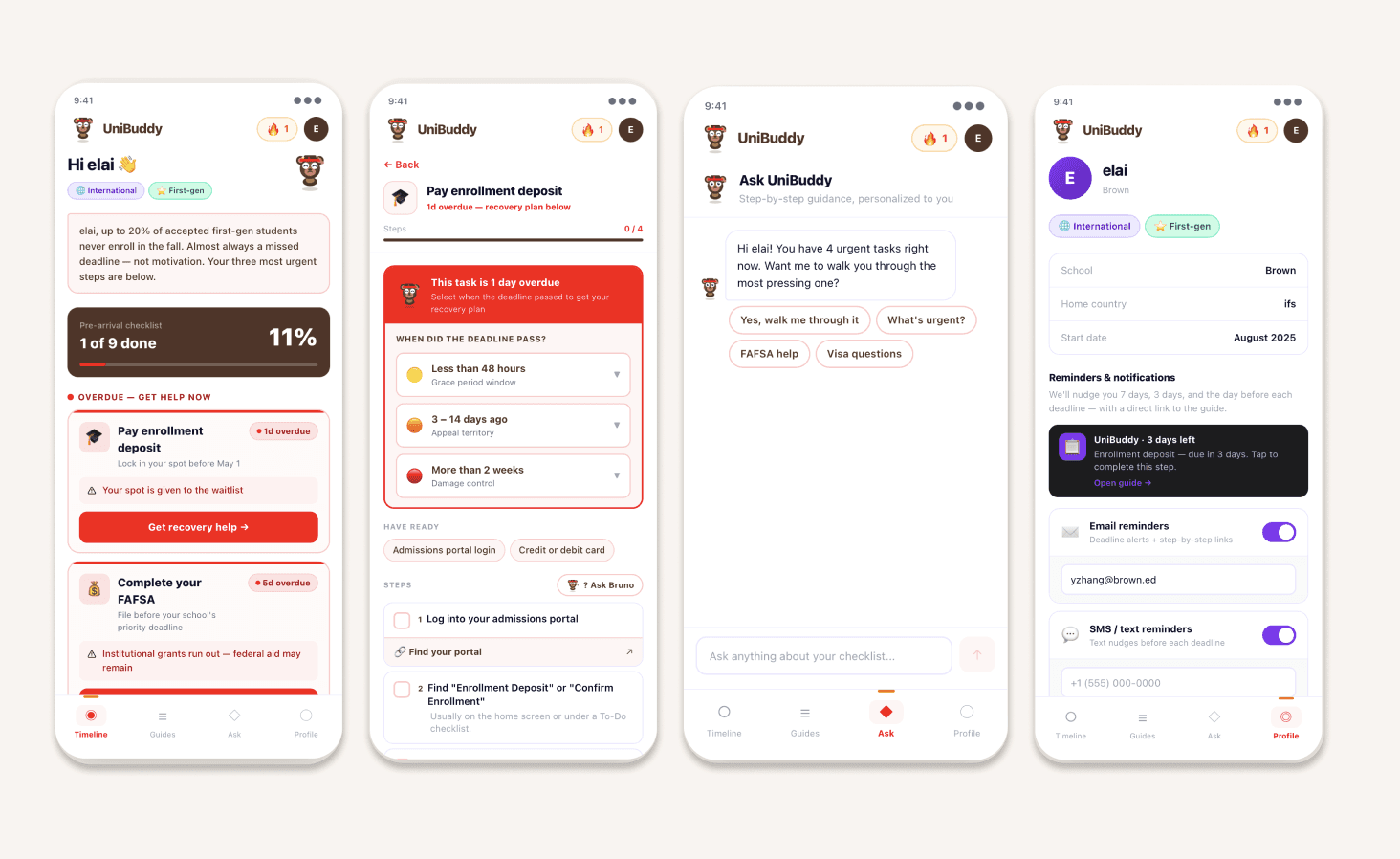
Rebuilt around a personalized timeline. Added a recovery flow for missed deadlines, an Ask screen for contextual help, and reminders across email and SMS.
What worked
The overdue-recovery flow gave students a clear next move instead of panic.
Most-requested
Ready-to-send email drafts and deadline reminders across email and SMS.
Task interaction flow
↻Prototype Walkthrough
Built with React and Claude Code. Try it live, then explore each core interface below.
01 · Home
Timeline
Every task, ranked by urgency and consequence. Students see what's due, what it unlocks, and what breaks if they miss a step.
02 · Guides
Process Guide
Each task opens into a step-by-step guide: who to contact, what to bring, and a ready-to-send email draft.
03 · Embedded
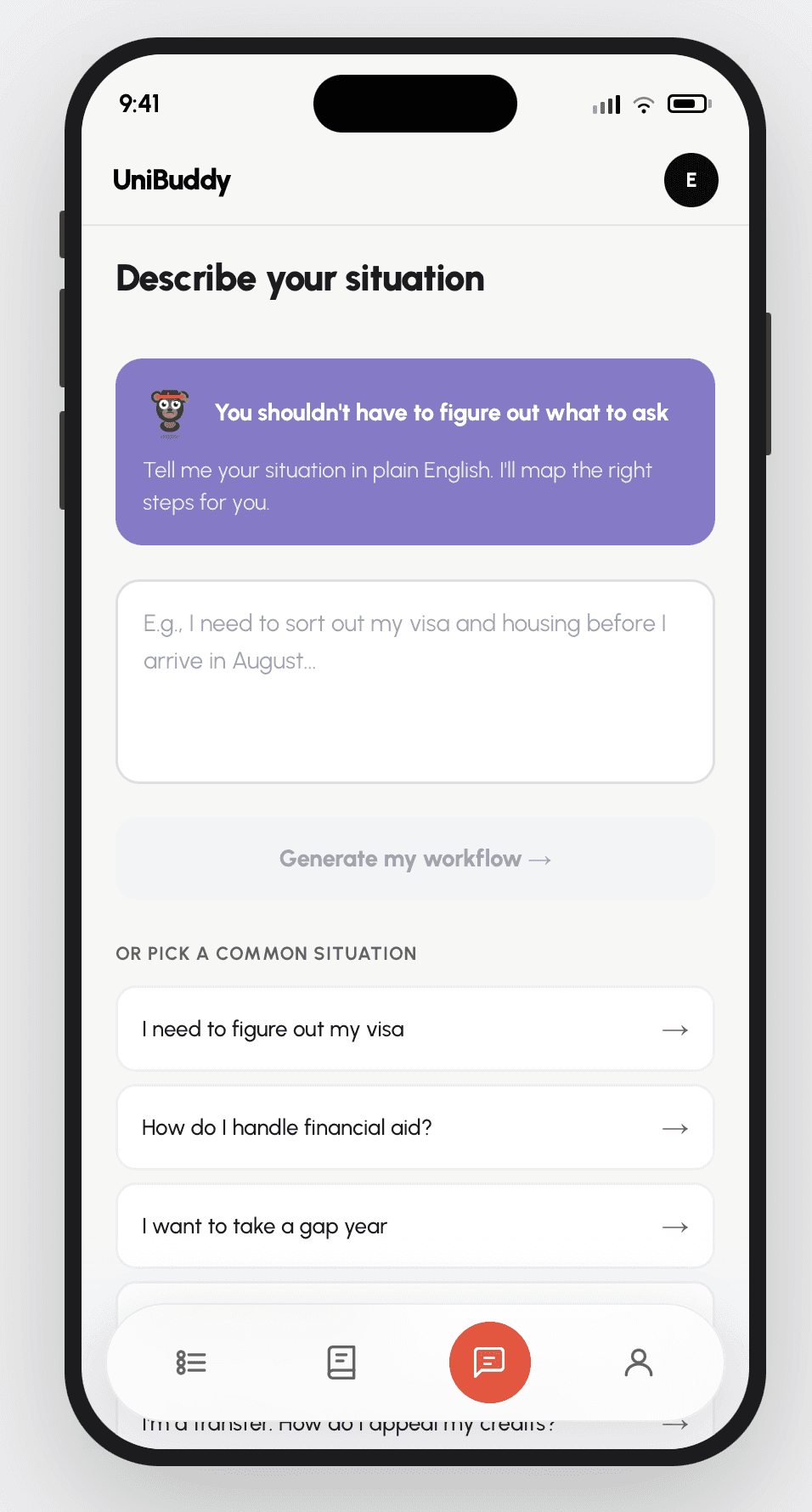
AI Guidance
It's not a chatbot. It's an AI case manager built into every workflow. Describe a goal like taking a gap year, and it lays out the offices, forms, and deadlines, then walks you through each step.
Testing
The smaller prototype won every time.
4
Archetypes tested
First-gen, second-gen, international, transfer
2
Test rounds
Phase 2 then Phase 3, same participants each time
What testing confirmed
Spelling out the consequences got students to act. Vague urgency did nothing.
Outcomes
Three screens, focused on the moment students need the most help.
Key Decisions
Cut
Community feed
Peer knowledge embedded as one verified insight per task instead.
Standalone AI tab
AI appears inline inside each guide, pre-filled with student context.
Growth tracking
Students want completion, not habit metrics.
Career planning
Wrong moment. Out of scope for the pre-arrival window.
Kept
Consequence lines on every task
The consequence line felt like clarity I never got. (Muzi)
Dependency mapping
Every archetype named this as what they wished had existed.
Office directory with context
When to contact and what to bring. This fixed Kathryn's main frustration.
Ready-to-send email drafts
Removes the highest-friction step: knowing what to say and to whom.
Financial Model
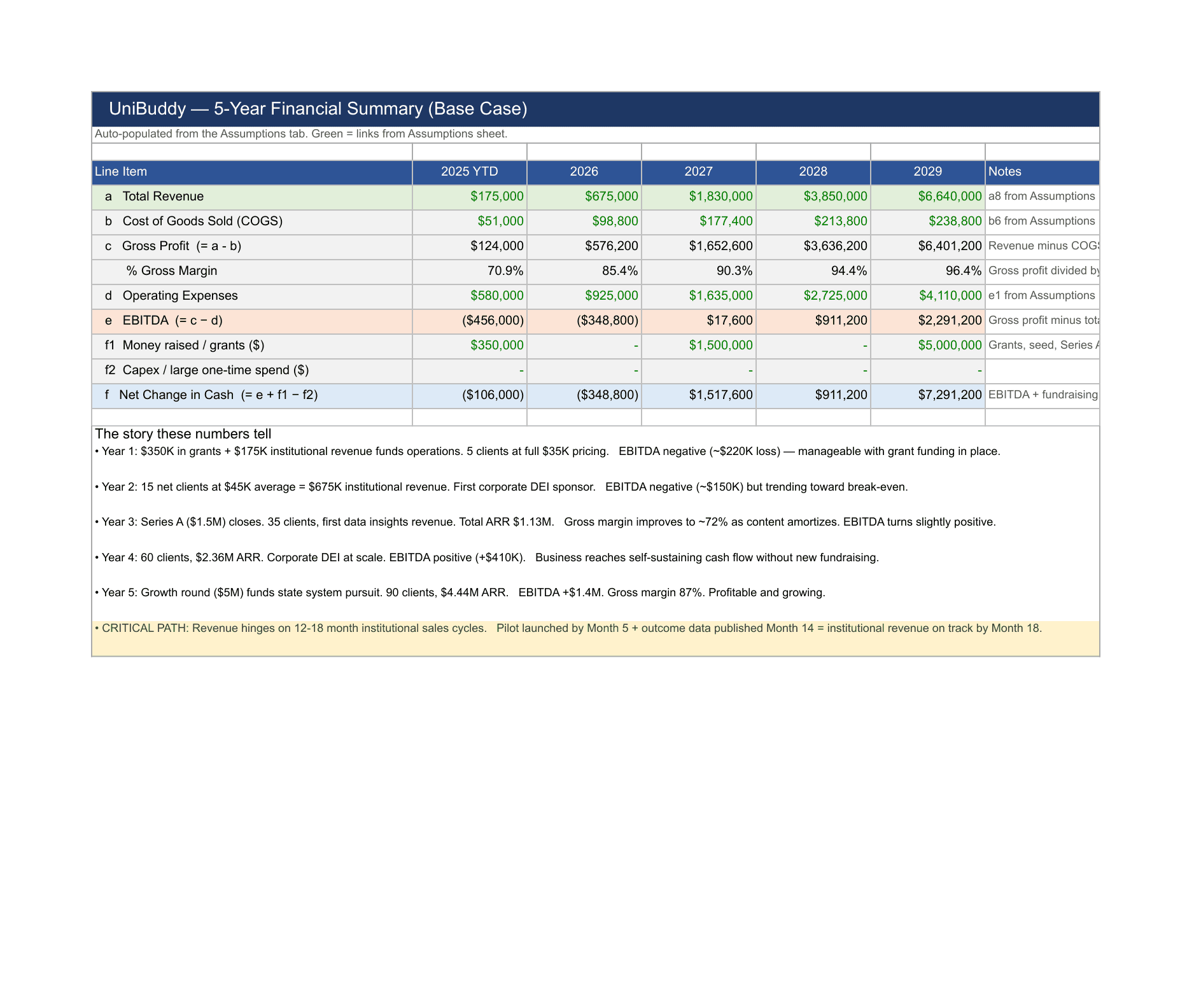
B2B institutional licensing. Profitable by Year 3.
$175K
Year 1 revenue
5 pilot institutions
$1.83M
Year 3 ARR
EBITDA turns positive
72%
Gross margin at scale
90 institutions
$6.64M
Year 5 revenue
Full rollout
Deployment Plan
Phase 01
Summer 2026
Closed Pilot
50-100 students, Brown + RISD
Manual task DB, 2 institutions
Target: 80% task completion
Phase 02
Fall 2026
Institutional Pilot
3-5 universities via TRIO / ISS
Admin dashboard + cohort analytics
Target: measurable ISS volume drop
Phase 03
Spring 2027
Public Launch
App Store + Google Play
Campus ambassador growth loop
Target: 10K MAU, under $6 CAC
Retrospect
Feature removal as design
Every Phase 3 cut improved performance. Three screens outperformed eight.
Accuracy over coverage
Visa deadlines need correct information, not crowdsourced information.
The transfer gap
Transfer student credit advocacy is the clearest v2 direction, and no existing tool covers it.
Professor Saloni Gupta
EDUC 1775, Brown University
Iman
Research and prototyping partner, interviews, synthesis, prototype development
Muzi, Kathryn, Akshay, Peter
Research participants, two rounds of interviews and prototype testing